Updated August 2026.
This article now reflects DCG’s current showroom and consignment standards.
A consignment showroom is shaped as much by what it declines as by what it accepts.
The floor cannot be an archive of everything available in San Diego. Every sofa, table, artwork, cabinet, lamp, and object takes physical space, requires handling, photography, staging, description, customer attention, and a credible path to its next home.
Selection is not a declaration that one style is good and another is bad. It is a judgment about whether a particular piece can contribute to this particular room, in its actual condition, at its actual scale, under a real resale process.
The piece has to earn the space
A piece earns space when several things are true at once:
- Its design, material, function, maker, story, or presence gives the floor something worth showing.
- Its condition is appropriate for display and sale without requiring DCG to clean, repair, assemble, or apologize for it.
- Its scale and logistics are proportionate to its likely buyer interest and resale value.
- It can be described honestly from the evidence available.
- It does not displace a stronger object merely because it is technically usable.
A familiar maker can help, but it is not a substitute for condition. An unusual silhouette can help, but it is not a substitute for function. A low proposed price can help, but it does not make every large object efficient to handle.
Condition is part of the design
Condition is not a footnote added after the aesthetic decision. It changes how the piece reads and what the next owner is being asked to accept.
Honest patina can deepen an object. Sun bleaching, water damage, unstable joints, odors, failed mechanisms, torn upholstery, missing components, or unfinished repair work can undermine it. The distinction depends on the actual item, not a blanket rule about age.
This is one reason clear intake photographs and accurate dimensions matter. The evaluation must be based on the object that would arrive—not on a manufacturer image, a memory, or a description of what it looked like before storage.
Function must survive the first impression
A chair should be more than photogenic. A table should stand correctly and provide the clearances its use requires. Drawers, doors, swivels, leaves, recliners, locks, lights, and other mechanisms should be judged as working parts rather than decorative claims.
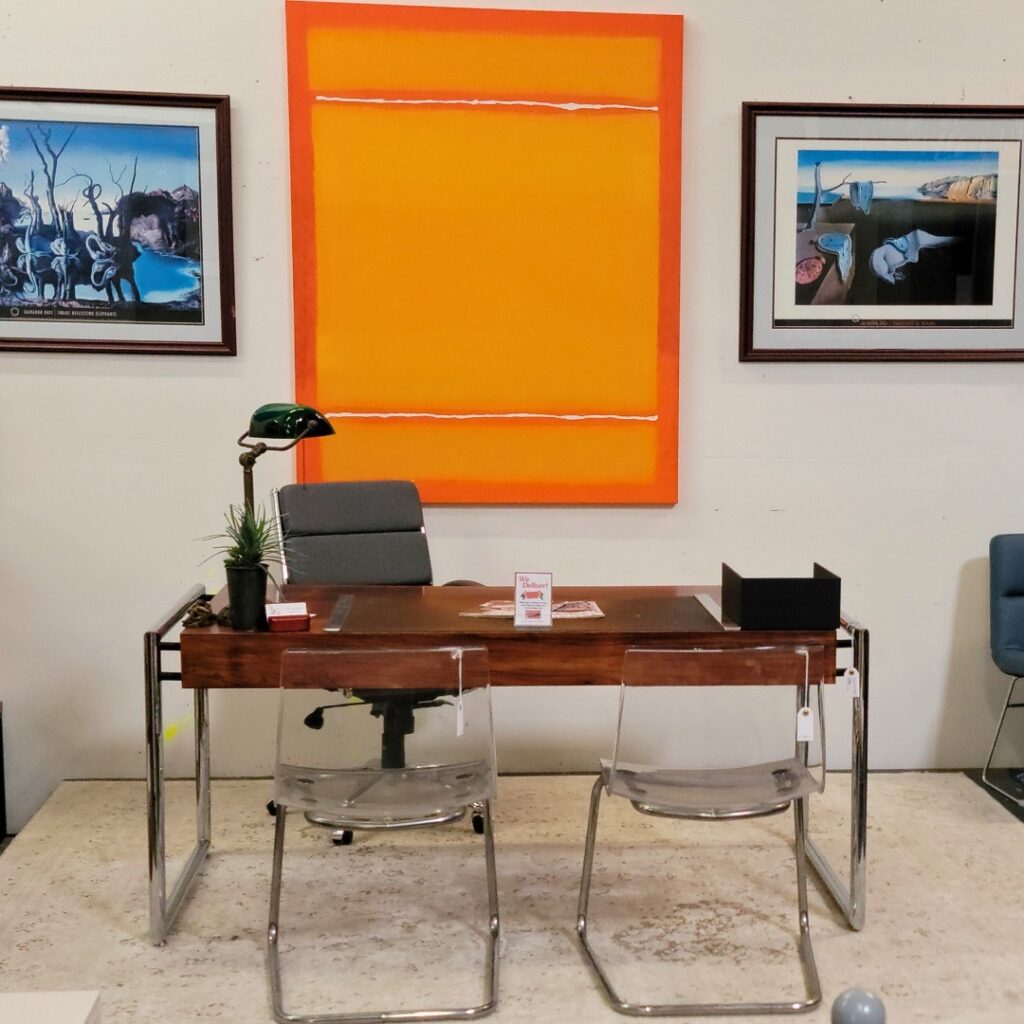
This is one reason the physical gallery matters. Materials, scale, condition, and mechanisms can be experienced in person before the decision is made.
Materials matter without becoming a purity test
The floor favors pieces whose materials and construction support their intended use. That does not reduce to “solid wood good, everything else bad.” Veneer can be expertly executed. Metal, glass, upholstery, stone, composite material, and mixed construction all have legitimate roles.
The useful questions are specific:
- Is the construction appropriate for the load and function?
- Are the surfaces, edges, seams, joints, and hardware in presentable condition?
- Can the piece be maintained or repaired on terms that make sense?
- Does the material still contribute to the room rather than merely imitate something else?
For a buyer’s version of that inspection, read The Death of Fast Furniture.
Presence without noise
Not everything needs to be loud. But nothing should be forgettable.
Some pieces hold a room through silhouette. Others through material, color, scale, or an unusually resolved detail. Some arrive with documented maker or provenance. Others simply arrive with presence. Both can matter, provided the description remains honest about what is known.
The smaller visual relationships that emerge from this process are the subject of Easter Eggs at DCG.
That is the direction: fewer inherited labels, clearer standards, and a floor where every piece has to justify the space it occupies.
See the details that make the floor worth a second look, then compare the principle with current inventory.
Think your piece belongs on the floor?
Review the condition, photograph, measurement, logistics, and submission requirements before sending it for evaluation.
Review the consignment requirements and submit a piece for consideration