Past-object archive · Updated August 2026.
The documented set is no longer on the floor. Legacy specifications below are attributed to DCG’s original listing and should not be assumed to describe another example without verification.
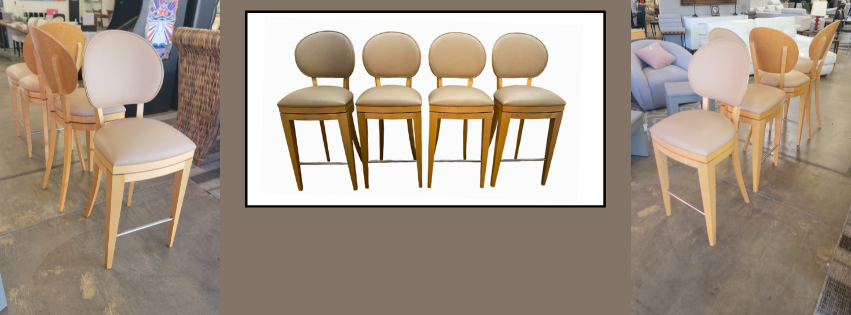
The set of four Berman Rosetti Jake swivel bar stools documented here is gone.
They remain worth discussing because a trace of an object can still contain much to learn.
The oval backs arrived first visually: restrained curves, neither aggressively modern nor burdened with ornament. Then the footrests, the swivel action, the soft taupe upholstery, and the way the set held its place without demanding that the rest of the room reorganize around it.
DCG’s original record described the stools as the Berman Rosetti Jake model, a set of four with a 31-inch seat height, oval backs, taupe leatherette, brushed-metal footrests, self-return swivel action, solid-maple construction, and California manufacture.
Those construction and origin details were not independently corroborated for this revision with a manufacturer record, invoice, or label photograph. They are preserved as the gallery’s historical documentation—not converted into universal facts about every Jake stool a reader may encounter.
Bar height is not a guess
The original set was documented with a 31-inch seat height, which placed it in bar-height territory. Do not choose a stool from the word “bar” or “counter” alone.
Measure:
- the finished floor to the top of the seat;
- the finished floor to the underside of the counter or bar;
- any apron, rail, or overhang that reduces knee space;
- the seat width and the clearance between stools;
- the path required for the seat to swivel without striking a wall, cabinet, or neighboring stool.
Then sit in the actual piece. The back angle, footrest position, cushion compression, and relationship between seat and work surface cannot be settled by a category label.
How to inspect a preowned swivel stool
- Set it on a level surface and test for wobble before blaming the floor.
- Hold the base steady and check movement at the joints between legs, rails, footrest, seat, and back.
- Rotate through the full intended range. Listen and feel for grinding, looseness, or an uneven return.
- Inspect the footrest where shoes make repeated contact. Finish wear may be ordinary; looseness or a separating joint is a different condition.
- Check upholstery at the front edge, seams, corners, and attachment points. Confirm whether marks are surface wear, a split covering, or damage below.
- Look for maker labels or documentation and photograph them. Attribute only what the evidence supports.
That last rule applies beyond stools. The Death of Fast Furniture is DCG’s broader guide to construction, condition, repairability, and fit.
Why this set remains in the journal
Exact maker-and-model records can outlive the inventory that created them. A future owner may be checking the seat height. A designer may be trying to identify the silhouette. A buyer may simply need a better method for judging the next swivel stool in front of them.
These Jake stools are no longer on the floor. The article remains because sold pieces can still highlight what’s worth noticing—and because this set carried a quality that deserves its own words.
Not loud.
Not trendy.
Just savage calm, well resolved.
The Jake set is gone. The inspection method still applies.
Compare current seating by scale, comfort, condition, construction, and actual seat height.